
2025-11-27
Dr. Pongsak Wonglertkunakorn
Can We Encourage Our Staff to Use AI Without Feeling Threatened by It?
Dr. Pongsak Wonglertkunakorn
- Workplace Consultant
- Ph.D. in Management from National Institute of Development Administration
- M.S. in Computer and Information Science from University of Pennsylvania
- B.Eng. in Computer Engineering from Chulalongkorn University
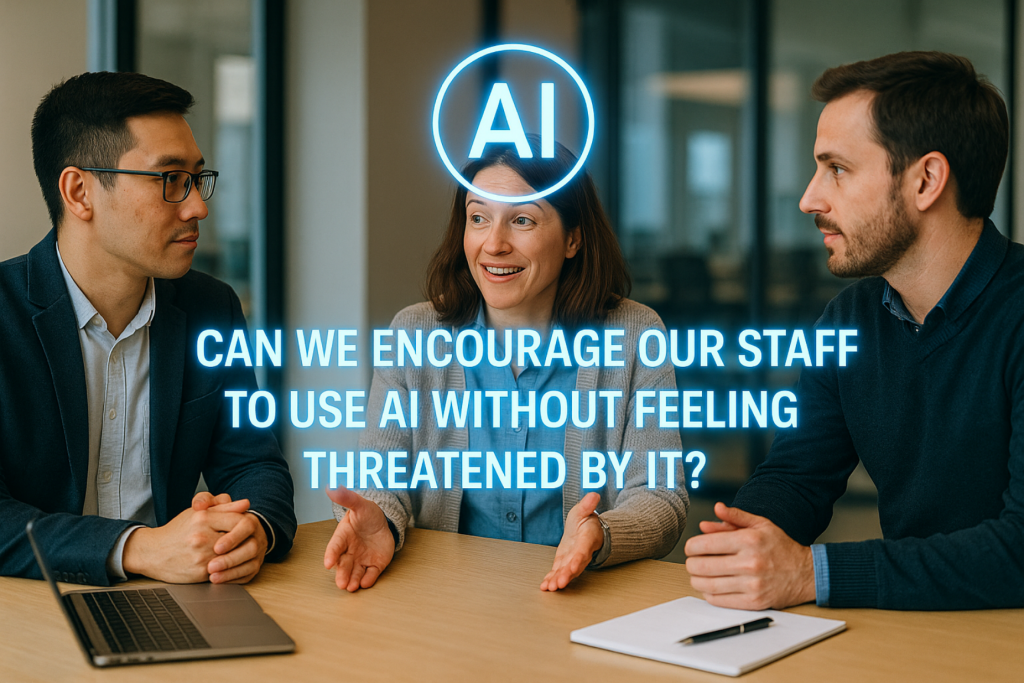
As AI becomes more deeply embedded in the workplace, one of the biggest challenges isn’t the technology itself—it’s how people feel about it. Many employees worry that AI might replace their roles or reduce their importance in the organization. As someone who works at Bainisys and sees transformation inside modern workplaces every day, I’ve learned that the key to adoption isn’t about forcing AI into workflows. It’s about building trust.
Employees don’t fear AI because of what it can do.
They fear AI because they’re unsure what it means for them.
To encourage healthy adoption, organizations need to shift the conversation from “AI vs Humans” to “AI + Humans.” AI should be introduced as a supportive tool that enhances performance rather than evaluates or replaces it.
Here are three practical approaches that work:
1. Show AI as a partner, not a judge
AI should help complete tasks—not assess or rank employees.
When people see AI reducing their workload instead of scrutinizing them, they open up to using it naturally.
2. Provide real examples of how AI saves time
When employees experience the convenience—automatic summaries, room booking optimization, workload reduction—they realize AI is here to make their job easier, not harder.
3. Encourage experimentation without pressure
Let employees play with AI tools freely.
When they learn at their own pace, curiosity replaces fear.
In tools like Roomminister, AI works mostly behind the scenes: predicting room usage, preventing booking conflicts, helping teams stay organized. When users feel supported rather than monitored, AI becomes a welcome part of daily work.
The real goal is to make AI feel like a reliable helper—not a competitor.
Once that mindset shifts, adoption becomes natural, even enthusiastic.
Let employees play with AI tools freely.
When they learn at their own pace, curiosity replaces fear.In tools like Roomminister, AI works mostly behind the scenes: predicting room usage, preventing booking conflicts, helping teams stay organized. When users feel supported rather than monitored, AI becomes a welcome part of daily work.
The real goal is to make AI feel like a reliable helper—not a competitor.
Once that mindset shifts, adoption becomes natural, even enthusiastic.